

The Cost of Public Spaces
Protecting Sacred Spaces

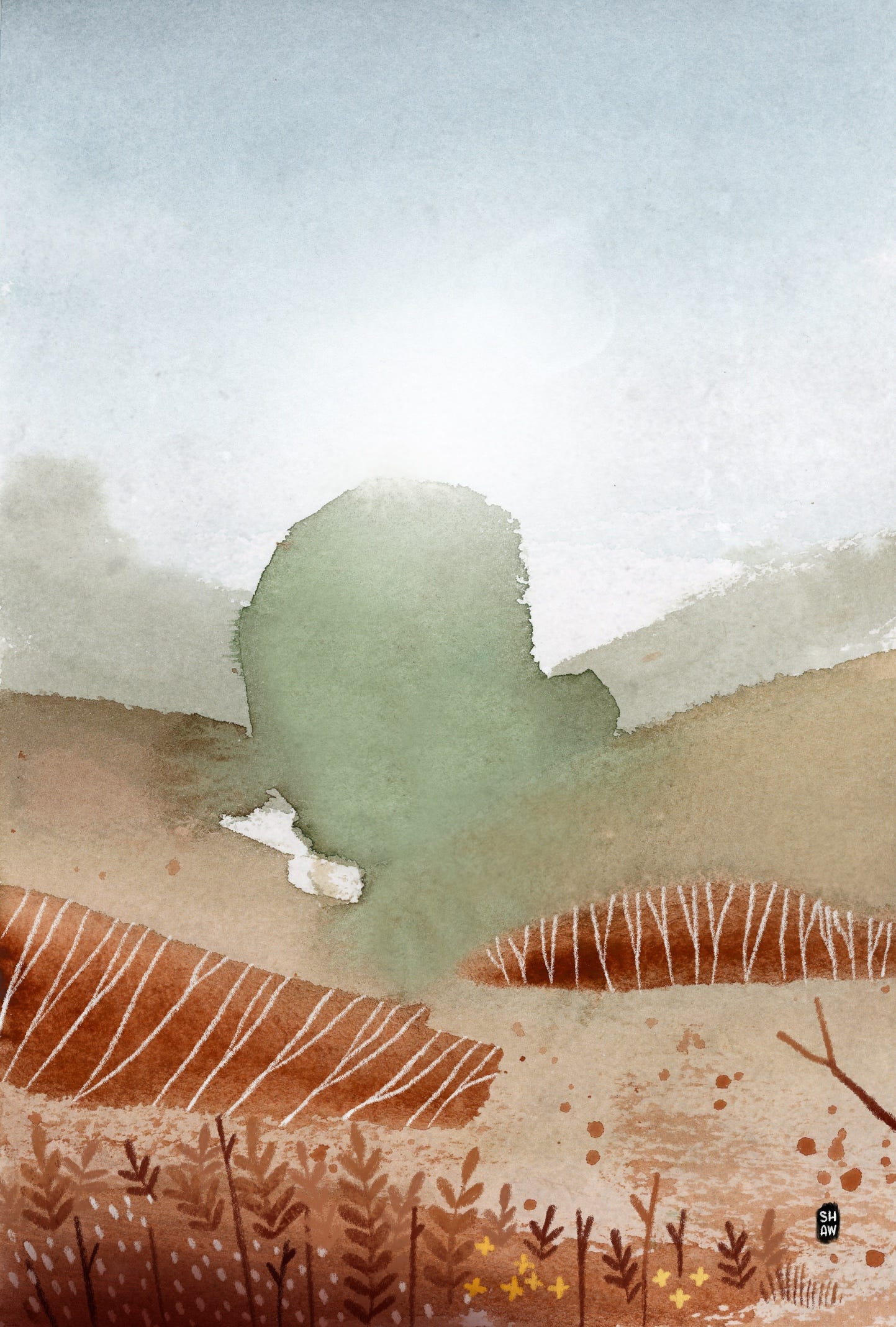
There is a hidden hike near my house that leads to a grove of juniper trees. It is relatively secluded between four dry hillsides, but by most standards, it is an unattractive site for a walk.
Nevertheless, I see the beauty and ancient quality of the sparse trees standing here and there like sentinels above everything else, their twisted trunks and gnarled branches like the bones of an elder woman, speaking resilience and strength.
I have spent hours in the grove, especially in the fall when the evergreens create a beautiful tapestry against the ochre Earth. I have come to know the place well. A barn owl, who I have named Isolde, lives there. Deer often visit to munch on berries, while rabbits run from cover to cover. The trees have old souls. The ground is rocky, with beautiful spines jutting up from the dirt. It is a place of stillness, hidden from the wind. You cannot see the city and most days you won't see another person. However, people do visit.
Recently, I noticed that someone created an ATV trail to the grove. They didn't do it with permits. They just drove right over the top of the hillside in the rain, leaving deep scars for others to follow. They built a five-foot-diameter fire pit in the center of the grove right in front of an extraordinarily tall juniper that I bring water to in dry weeks and placed two leather couches around it. After only a short while, many of the trees were cut down with an axe or saw, and I picked up numerous cans of alcohol and counted thousands of rusty nails littered across the ground. Propped against one of the trees is a car hood dented with bullet holes.
There are not many spaces like this in these hills. They are dry. It is a desert. I know that people can sense the grove's specialness, which draws them in, but they don't know how to treat special places for some reason. They don't know the trees are ancient, they don't know about Isolde, or perhaps they don't know how to enter her home respectfully. Because no one is there to police them, they leave trash everywhere.
I've always felt that public spaces are incredibly important. However, the "public" aspect of public property often reminds me why privacy is so appealing. When a dog comes barreling towards me on the trail, when I'm cleaning up after someone else's pet, when people disrupt or abuse nature, when human infrastructure engulfs open spaces, when their constant light banishes darkness, and when we are all crammed together like sardines surrounded by strangers—it really highlights the challenges of communal living for me.
A part of this is my annoyance with the public more than anything else, which I attribute to an illness caused by modern-day society and a culture that values the self over anything else.
Last year, I wrote several posts about how we are not culturally or ethically prepared for technological advancements past, present, or future. I have similar concerns about communal living. We are not ready to thrive together as a close-knit community. That readiness was buried with the bodies of the indigenous peoples we killed and displaced. As if that wasn't enough, technology continues to isolate us from nature and one another, making it that much harder to increase our readiness. To coexist, we need mutual respect and stewardship for our collective well-being and the environment, but it is lacking, rendering public spaces hostile and unwelcoming to the soul.
In my view, people's disconnect between the specialness of a grove of Junipers and how they treat it is because nature is no longer deeply intertwined with our survival. However, we can resolve that by developing a culture around nature. I just returned from Scotland and was impressed by their shared responsibility for water conservation, recycling, and open spaces. It is likely because their identity is tied not only to their nation but to the land and water. We can actually mend that here, too. Culture and identity are not static; they are flexible, and we can change them however we like.
Believe it or not, we can create shared myths centered around nature and our connection to one another and Earth. We already have them in many cases, but we need to emphasize them. We can make those myths a natural part of our everyday lives rather than something found in religion. We are not bound to this state where we don't know how to respect sacred places. We can learn it.
"I do not think the measure of a civilization is how tall its buildings of concrete are, but rather how well its people have learned to relate to their environment and fellow man." -Sun Bear, Chippewa